
The Ultimate Guide to Musical Notes: Western Chromatic Scale
vs.
Hindustani Swaras
Music is a universal language, but its “alphabets” are written differently across the globe. For any aspiring musician, producer, or student, understanding the correlation between Western Music Theory and Indian Classical Music (Hindustani Sangeet) is the first step toward mastery.
If you have ever wondered how C, D, E translate to Sa, Re, Ga, this guide is designed for you.
The Concept of 12 Semitones
In both systems, an octave is divided into 12 semitones. While Western music refers to them as “Chromatic Notes,” Hindustani music calls them “Swaras.” The primary difference lies in their application: Western music is based on Absolute Pitch (where C is a fixed frequency), whereas Indian music is based on Relative Pitch (where ‘Sa’ can be any note depending on the singer’s range).
The 12 Notes Comparison
In Hindustani music, the notes are divided into three categories: Shuddha, Komal, and Teevra.
A. Shuddha Swar (Natural Notes)
There are 7 Shuddha (natural) notes in Hindustani music:
Sa (Shadja): Equivalent to Western C
Re (Rishabh): Equivalent to Western D
Ga (Gandhar): Equivalent to Western E
Ma (Madhyam): Equivalent to Western F
Pa (Pancham): Equivalent to Western G
Dha (Dhaivat): Equivalent to Western A
Ni (Nishad): Equivalent to Western B
B. Komal Swar (Flat Notes)
When a note is played half-a-step lower than its original position, it is called ‘Komal.’ In Western music, this is known as a “Flat” (b).
Komal Re (re): C# or Db
Komal Ga (ga): D# or Eb
Komal Dha (dha): G# or Ab
Komal Ni (ni): A# or Bb
C. Teevra Swar (Sharp Note)
When a note is played half-a-step higher than its original position, it is called ‘Teevra.’ In Western music, this is a “Sharp” (#).
Teevra Ma (Ma’): F# or Gb
Comparison Chart: Western vs. Indian
Below is the mapping of the 12 notes, assuming C as the Tonic (Sa).
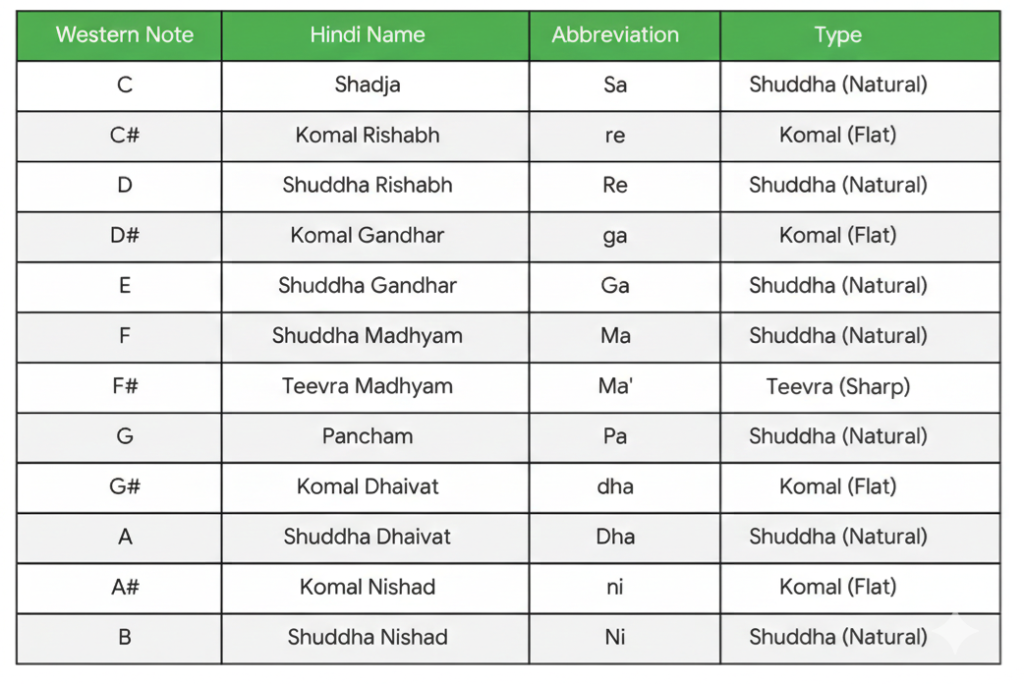
Key Terms Explained: Shuddha, Komal, and Teevra
To navigate the world of Indian Classical Music Notation, you must understand the three types of Swaras:
Shuddha Swaras (Natural Notes): These are the 7 primary notes: Sa, Re, Ga, Ma, Pa, Dha, Ni. On a piano, if you start from C, these correspond to all the white keys.
Komal Swaras (Flat Notes): There are 4 Komal Swaras—re, ga, dha, and ni. These are played one semitone lower than their natural counterparts.
Teevra Swara (Sharp Note): In Indian music, only Madhyam (Ma) can be Teevra. It is played one semitone higher than the natural Ma.
The “Achal” Swaras (Immovable Notes)
In Hindustani music, Sa (C) and Pa (G) are known as Achal Swaras. They are fixed and do not have any flat or sharp variations. They act as the pillars of any Raga.
Decoding Music Theory: Major Scales vs. Indian Ragas
One of the most effective ways to learn music is to relate Western Scales to Indian Ragas.
The Ionian Mode (C Major Scale): This is identical to Raag Bilawal. It uses all Shuddha (natural) notes.
The Aeolian Mode (Natural Minor Scale): This closely resembles Raag Asavari (using Komal re, ga, dha, and ni depending on the ascent/descent).
The Lydian Mode: This matches Raag Yaman, which is famous for using the Teevra Ma (F#) instead of the natural F.
Why Should You Learn Both Systems?
If you are a music producer or a guitarist, knowing this mapping allows you to:
Compose Fusion Music: Blend Western harmonies with Indian melodic structures.
Transcribe Songs: Easily convert a Bollywood song into Western sheet music or MIDI.
Improve Ear Training: Understanding the “feel” of a Komal Swar vs. a Minor Note enhances your relative pitch.